

In the News, NIH, Research, Science
Michelle Brandt
on May 22nd, 2013
Science Insider took another look yesterday at the effects of the budget sequestration on research. After describing the potential harms of the NIH’s recently announced 5 percent budget cut - “part of a larger pattern of declining funding over the past decade” – reporter Jocelyn Kaiser points out another troubling aspect of sequestration:
NIH leaders say that the sequester’s most severe effect is the chilling message it sends to young scientists. In testimony last week, [NIH Director Francis Collins, MD, PhD,] quoted a former student who is finishing a Ph.D. at the Massachusetts Institute of Technology. She’s seen her role models struggle with funding. “I can’t erase the fear that this is my future,” Collins quoted her writing.
“We’re putting an entire generation of U.S. scientists at risk,” Collins warned. “If they go away, they won’t come back.”
Previously: Sequestration hits the NIH – fewer new grants, smaller budgets, NIH director polls Twitter for real-world responses to budget cutbacks and As budget sequester nears, a call for Congress to protect funding for scientific and medical research
Neuroscience, Research, Science, Stanford News, Videos
Michelle Brandt
on May 22nd, 2013
Each year the National Science Foundation runs a video contest for young IGERT-funded scientists to communicate to the public about their research, and viewers are encouraged to vote for their favorite videos by liking them on Facebook.
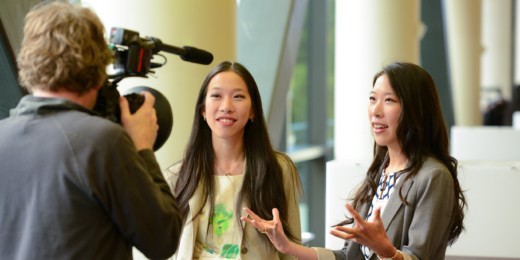
One of the entries in this year’s contest comes from a group of Stanford graduate students who show how the brain plans movement and discuss their work on neural prostheses - biomedical devices for restoring movement to individuals with paralysis or lost limbs. The students, who are all part of the Stanford Center for Mind, Brain and Computation, conduct their work in the labs of electrical engineer Krishna Shenoy, PhD, whose research we’ve written about in the past, and Surya Ganguli, PhD, an assistant professor of applied physics.
The take-away message of the video, student Sergey Stavisky told me yesterday, is that “neural prosthetics are an exciting class of medical technology with the potential to improve the lives of individuals with paralysis,” but that to develop better ones, “we still need to learn a lot about the basic science of how the brain controls movement.”
The video, called “Neural Prosthetics: Understanding Reach Planning,” is worth checking out, as are many of the other entries, whose topics range from “virtual blood vessels” to the use of stem cells to revitalize skeletal muscle. Voting is open until 7 PM Pacific time Thursday.
Previously: Researchers find neurons fire rhythmically to create movement and Stanford researchers uncover the neural process behind reaction time
Via Erica Seigneur from NeuroTalk
Video still courtesy of Sergey Stavisky
Medicine and Literature, Science
Michelle Brandt
on May 21st, 2013
I’ve been a fan of Pulitzer Prize-winning science writer Deborah Blum since a colleague gave me Blum’s book “Sex on the Brain” more than a decade ago. (Another reason to like Blum: She teaches journalism at my alma mater.) So I was interested to see a Q&A with her over on the Communication Breakdown blog today. There Blum discusses, among other things, her move from writing news stories to penning books, her propensity to delve into the history of science in her writing, and her decision to start blogging:
CB: You started the Elemental blog on Wired Science in 2010, while still continuing to write freelance news pieces and working on your books. Given all of the outlets that you had for your writing, why start a blog?
Blum: Really it was the reverse process of “The Monkey Wars.” There I wrote a newspaper series and realized that there was a much larger story I wanted to tell, that it justified a book. Here I wrote a book ["The Poisoners Handbook"] and realized there were many smaller stories I wanted to tell – poisons that I still wanted to write about, stories that I’d left out of my book. And I wanted to bring the subject forward – to connect the toxicology of the past with chemical exposures today. That’s really important to me.
Previously: Science writing that’s fun to read and Public Library of Science launches new blog network
Chronic Disease
Michelle Brandt
on May 20th, 2013
What can be learned from posts written on online forums by patients – many with chronic disease – and their caregivers? The online health community of Inspire recently had its five millionth post, and founder and CEO Brian Loew offers a few lessons via Health Care Communication News today:
Patients want doctors to treat them as partners. Patients expect their doctors to listen to them not only about their symptoms, but also about their own perspectives on their condition. To be clear, patients don’t want to play doctor, but many patients—especially those with rare diseases—become highly educated about their condition and have done research which they believe bears consideration. The asymmetry of medical information available to patients versus doctors is almost gone, and today any one of us can go online to learn a great deal about a medical condition.
Patients are less cynical about pharma companies than you’d think. Patients want the medical system to work for them. They want pharma companies to make the drugs that help them and their loved ones. When we started Inspire, we were warned that patients would be overwhelmingly negative about pharma companies. This is simply not what we see. What we do see is a lot of discussion about how to optimize treatment, and a genuine interest among patients to best to benefit from their treatments.
Patients are not online just to vent. In our experience, patients seek three kinds of support: emotional, scientific, and practical. Many patients get scientific support from their physicians and online encyclopedic sources. But they are also hungry for practical information to improve their health, and they gather a lot of this information from their peers online. In two recent Inspire surveys—one of psoriasis patients, and another patients with the rare disease neurofibromatosis—each group said the primary reason they participated in online groups was to research the best available treatments. Emotional support and empathy are important, no doubt. But many patients share crucial practical information that only fellow patients know.
Previously: Experts by experience: A year’s worth of patient stories, Doctors: Please have “ears that hear” and Zebras with different stripes: One patient’s story
Global Health, Public Health, Research, Stanford News
Michelle Brandt
on May 17th, 2013
Stanford engineers have developed a nanoparticle that could lead to a new way to purify water. In a press release, writer Andrew Myers provides details on the work – which involves the use of magnetism to clear the synthetic “nanoscavenger” from the water – and describes researchers’ hope to “create a ‘one-pot solution’ that tackles water afflicted by a diverse mixture of contaminants.” Given that 1.6 million people die each year from diarrheal diseases stemming from lack of access to safe drinking water and basic sanitation, such purification technology could have big public-health implications.
Previously: Waste not, want not, say global sanitation innovators
NIH, Research, Science, Science Policy
Michelle Brandt
on May 16th, 2013
The importance of the physician-scientist is the focus of a new Perspective piece in the New England Journal of Medicine. Writing that an increasing number of MDs have moved away from the laboratory and into clinical practice, and calling the shortfall of new physician-researchers a “national, if not global, concern,” Michael M. Gottesman, MD, outlines how the National Institutes of Health is working to reverse the trend. And he notes that the awarding of the 2012 Nobel Prize in Chemistry (which went to Robert Lefkowitz, MD, and Stanford’s Brian Kobilka, MD, both trained in cardiology) “should remind us of the critical role that clinician-scientists have played in formulating the seminal concepts that govern modern biomedical science.”
Previously: Funding basic science leads to clinical discoveries, eventually, Why basic research is the venture capital of the biomedical world, At press conference, Nobel Laureate Brian Kobilka discusses his research and “irrational optimism” and Stanford’s Brian Kobilka wins 2012 Nobel Prize in Chemistry
Mental Health, Neuroscience, Research
Michelle Brandt
on May 13th, 2013
In a paper published online this afternoon in Proceedings of the National Academy of Sciences, researchers provide for the first time direct evidence that the brain’s master clock is disrupted in people with depression. A University of Michigan release offers these details:
The team uses material from donated brains obtained shortly after death, along with extensive clinical information about the individual. Numerous regions of each brain are dissected by hand or even with lasers that can capture more specialized cell types, then analyzed to measure gene activity. The resulting flood of information is picked apart with advanced data-mining tools.
Lead author Jun Li, Ph.D., an assistant professor in the U-M Department of Human Genetics, describes how this approach allowed the team to accurately back-predict the hour of the day when each non-depressed individual died – literally plotting them out on a 24-hour clock by noting which genes were active at the time they died. They looked at 12,000 gene transcripts isolated from six regions of 55 brains from people who did not have depression.
This provided a detailed understanding of how gene activity varied throughout the day in the brain regions studied. But when the team tried to do the same in the brains of 34 depressed individuals, the gene activity was off by hours. The cells looked as if it were an entirely different time of day.
The study authors, which include Stanford’s Alan Schatzberg, MD, PhD, say that having knowledge of these altered circadian rhythms could help with the diagnosis and treatment of depressive disorders. “We need to learn more about whether something in the nature of the clock itself is affected, because if you could fix the clock you might be able to help people get better,” Michigan’s Huda Akil, PhD, explained.
Patient Care, Stanford News
Michelle Brandt
on May 2nd, 2013
Yesterday marked a big day for Stanford and the local community: Ground was broken for the new Stanford Hospital & Clinics. As Ruth Schechter reports in our online story:
Scheduled to open to patients in 2018, the new building will optimize the hospital’s services and infrastructure, adding more beds, private rooms, state-of-the-art operating suites, expanded emergency services and the flexibility the hospital needs to adapt to advancing technologies and more streamlined services.
The new 824,000-square-foot hospital will increase patient capacity to 600 beds and feature 368 individual patient rooms, an enlarged level-1 trauma center and an emergency department nearly three times the size of the current capacity. Designed by the internationally recognized firm Rafael Viñoly Architects, the project will feature amenities intended to enhance both physical and emotional healing with the latest in medical, surgical and diagnostic technology. The new building will be connected to the current hospital by a bridge and tunnel.
The new hospital will feature individual patient rooms centered on health and well-being, with expansive windows that provide natural light and integrated accommodations for family members to visit and spend the night. Patient rooms will be modular, allowing them to accommodate any level of acuity. A roof garden setting will create a quiet retreat for patients and families, and landscaping will feature native and drought-tolerant plants. The building also incorporates the latest innovations in green technology to reduce the hospital’s environmental impact.
About 400 community members, donors, and administrators, including Amir Dan Rubin, the hospital’s president and CEO, and Lloyd Minor, MD, dean of the School of Medicine, were on hand late yesterday to watch as “shiny red shovels were put to ceremonial dirt.”
Previously: Growing up: The expansion of Lucile Packard Children’s Hospital, Hospital mock-ups help refine plans before construction begins and City of Palo Alto approves rebuilding and expansion of Stanford Hospital and Lucile Packard Children’s Hospital
Rendering of new hospital from Rafael Viñoly Architects
Medical Schools, Parenting
Michelle Brandt
on April 30th, 2013
Getting through medical school and raising a child are two activities that on their own can each be challenging – not to mention exhausting. But what’s it like to do them simultaneously? In a candid piece on Mothers in Medicine (a blog that I consider a must-read for doctor-moms), a writer shares the less-positive aspect of her juggle:
I judge myself constantly. If I were not a medical student mom, I could have given my child a more even-keel life filled with playgroups, museum activities, more reading and less TV. Should I be doing those things despite needing to study and handle school and fatigue? Should I have done more anyway? Maybe sucked it up, because darn it – medical school moms are supposed to be smart and manage the house and family? Having it all and doing it all, right?
Now I’m looking backwards. I am less than two weeks from graduation as I write this, and I still judge myself for decisions I made in medical school. We did survive the away rotations despite living in a 350-sq ft apartment for one of them. We survived each of the Step exams and third year. We even survived a crazy interview season that involved many flights, and I matched somewhere that is perfect for my family. However, did I do enough of the right things to balance out the wrong ones? Should I just be thankful Sesame Street and Super Why! have taught my toddler all his letters and numbers? (Thanks PBS!) I don’t really know, but I console myself that he is a loving, sweet toddler who seems to somehow really love me…
Patient Care
Michelle Brandt
on April 29th, 2013
Blogger-physician Aaron Neinstein, MD, offers today a nice, brief reminder of how small things in health care can make such a big difference. Noting that he received a thick, comfortable cloth robe instead of the “humiliating, cold, and uncomfortable paper gown” at a recent dermatology appointment, he writes:
Small touches like this robe can make a dramatic difference in the patient experience. This does not mean that “luxury” can or should replace high-level medical care. However, thoughtful touches like this robe can enhance and augment high quality medical care to make it even better, and we should not ignore these opportunities to make our patients feel more comfortable.