

Published by
Stanford Medicine

Category

Medical Education

Medical Education, Stanford News

Congratulations to the Class of 2013!

congratulations-to-the-class-of-2013

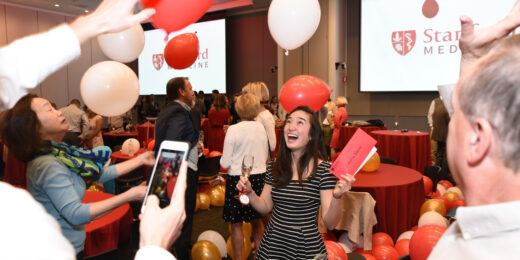
On Saturday, nearly 200 students walked away from the Stanford campus with a new title: Doctor! My colleague was on the scene at the medical school’s commencement, during which 95 members of the graduating class earned MDs, 91 earned PhDs or MD/PhDs, and 39 earned master’s degrees. More images from the day, which featured a keynote address from Nobel Prize winner Brian Kobilka, MD, can also be found on the medical school’s Flickr page.

Previously: Stanford medical school alum fulfills lifelong dream to participate in commencement ceremony
Photo by Norbert von der Groeben

Medical Education, Medical Schools, Stanford News, Technology

A closer look at using the “flipped classroom” model at the School of Medicine

As reported previously on Scope, the School of Medicine is developing a new online learning initiative to re-imagine medical education using the “flipped classroom” model. Titled the Stanford Medicine Interactive Learning Initiatives , the program aims to make better use of the fixed amount of educational time available to train doctors.

In a piece published today on the Health Care Blog, Michael Painter, JD, MD, a  senior program officer at the Robert Wood Johnson Foundation, recounts his visit to an ECG cardiology course at the medical school to observe how educators are using web-based videos to impart basic knowledge and reserving class time for more engaging activities. He writes:

This Stanford class-flipping experience is new—in fact, it’s just a week old—so I got to see it at its beginning.  In the first hour, Dr. [Paul] Wang essentially gave the video lecture again.  In the subsequent two-hour small group sessions, the students worked with teachers on ECG problem-solving and games.  They engaged well with the teachers and each other—and seemed to be using new vocabulary and identifying ECG patterns pretty adeptly by the end.

The dean, Dr. Charles Prober—a Stanford Medical School champion of moving medical education content into YouTube format and onto the Khan platform— was there.  Another local champion of this work, Dr. Drew Patterson, associate professor of anesthesiology, was there as well.  These leaders, Drs. Prober, Patterson and Wang, are creative and brave people.  They are trying to bring the first ripples of widening care transformation to fortress academia, and no doubt the status quo will not adjust quietly.  Both Drs. Prober and Patterson spoke passionately about the enormous potential of this technology along with changing attitudes about medical education.  They are trying hard to get their medical school to embrace that change and help lead it.

Previously: Combining online learning and the Socratic method to reinvent medical school courses, Using the “flipped classroom” model to re-imagine medical education, Rethinking the “sage on stage” model in medical education and Stanford professors propose re-imagining medical education with “lecture-less” classes

Medical Education, Medical Schools, Medicine and Society

A call to tap “latent creative” physicians in the medical community

a-call-to-tap-latent-creative-physicians-in-the-medical-community

What can medical schools and institutions do to better communicate with the public? According to physician-blogger Bryan Vartabedian, MD, the answer is to seek out and support “latent creative” physicians. He writes today on Wing of Zock:

Latent creatives are providers who love to write but never had permission and never had a platform. Latent creatives have strong opinions and amazing ideas just waiting to be shared, understood, labeled, tagged, and built upon. They have some unusual ability to speak in front of a camera, make diagrams, or collect and create images.

Medical leadership should be motivated to bring what’s inside their faculty out for everyone to see. Human attention centers around content—and where there’s attention, there’s money. This is the value proposition for dean and CEOs. But it goes beyond the bottom line.

For those doctors wondering how to carve out time in their busy schedules to “write, record and make,” Vartabedian talks more about how he overcame this challenge in a past Scope Q&A. Additionally, fellow physician-blogger Kevin Pho, MD, offers advice on how physicians can communicate online in this Q&A.

Previously: Social media advice from a physician-blogger, Advice for physicians when interacting with patients online, 33Charts’ Bryan Vartabedian talks about physician blogging and How can physicians manage their online persona? KevinMD offers guidance

Medical Education, Stanford News

Free online course on statistics and medicine starts today

free-online-course-on-statistics-and-medicine-starts-today

Need a little statistics to spice up your summer? As a reminder, today’s the start of a nine-week online class taught by Stanford’s Kristin Sainani, PhD. “Statistics in Medicine” is a free “MOOC” (or, massive open online course) that, as my colleague described last month, “aims to provide students with a foundational understanding of probability and statistics, teaching them the skills required to critically evaluate statistics in medical studies. It also shows students how to analyze and avoid common statistical pitfalls with their own research data.”

This week’s topic is “descriptive statistics and looking at data;” you can join the class through its webpage.

Previously: Stanford offers free “Statistics in Medicine” course, starting June 11

Clinical Trials, Medical Education, Medicine and Literature, Stanford News

Stanford offers free “Statistics in Medicine” course, starting June 11

stanford-offers-free-statistics-in-medicine-course-starting-june-11

Does eating red meat increase your risk of being in a traffic accident? Should you be worried about lead in lipstick? These and other provocative medical questions will be analyzed and discussed in the Stanford School of Medicine’s new online course “Statistics in Medicine.”

This nine-week massive open online course — or MOOC, for short — aims to provide students with a foundational understanding of probability and statistics, teaching them the skills required to critically evaluate statistics in medical studies. It also shows students how to analyze and avoid common statistical pitfalls with their own research data.

“Statistics in Medicine” will use real-world examples from medical literature and popular media to reinforce its lessons. The course instructor, Kristin Sainani, PhD, is a clinical assistant professor of health research and policy and is a recipient of several teaching awards from Stanford’s graduate program in epidemiology. Her first MOOC, “Writing in the Sciences,” has had almost 70,000 students register since it launched last fall.  The self-paced version of both of these courses can taken at any time, minus homework evaluations and teaching assistant support.

Previously: Free Stanford online course on child nutrition & cooking
Photo of Bayes’ theorem by MattBuck

Medical Education, Stanford News

A day at med school for Bay Area teens

a-day-at-med-school-for-bay-area-teens


Last month, a group of area high-schoolers came to Stanford for a taste of medical school. We shared photos of Med School 101 earlier in the week; this video provides a closer look at the program.

Previously: Highlights from Med School 2013, Image of the Week: Studying brains at Stanford’s Med School 101, Med school: Up close and personal, A quick primer on getting into medical school, Teens interested in medicine encouraged to “think beyond the obvious” and High-school students get a taste of med school

Medical Education, Medical Schools, Stanford News

Highlights from Med School 2013

highlights-from-med-school-2013

Last month, a group of 150 Bay Area high-school students visited Stanford to attend a series of hands-on, interactive sessions and lectures on a diverse range of subjects including biodesign, virtual anatomy, neuroscience and cancer. Their visit was part of our annual Med School 101 event, a day-long medical education program designed to expose teens to ongoing research at the School of Medicine and get them excited about potential careers in medicine and science.

This gallery illustrates some of the students’ exciting experiences, from performing procedures on simulated patients to examining animal brain tissue samples. To see more images from the day, visit our full photo set on Flickr.

Previously: Bay Area students get a front-row seat to practicing medicine, scientific research, Image of the Week: Studying brains at Stanford’s Med School 101, Live tweeting sessions at Stanford’s Med School 101, Med school: Up close and personalA quick primer on getting into medical schoolTeens interested in medicine encouraged to “think beyond the obvious” and High-school students get a taste of med school

Events, Medical Education, Research, Stanford News

As part of annual tradition, budding physician-scientists display their work

as-part-of-annual-tradition-budding-physician-scientists-display-their-work

From future stem cell researchers to budding international health experts, a crowd of aspiring physicians and scientists - about 45 Stanford MD and MD/PhD students – presented new research here last week at the 30th annual Stanford Medical Student Research Symposium.

An online article I wrote on the event describes a few of their projects, from a novel idea on screening premature babies for potential brain bleeds to the use of new immunosuppressant drugs to increase cell survival rate in cardiac stem cell treatments. I’ve covered this event several times now as a reporter, and I’m repeatedly amazed by the level of scientific research that medical students - many of whom work over the summer or during their “free” time – somehow squeeze into their busy schedules.

Laurence Baker, PhD, a professor of health research and policy who has been responsible for directing medical student research for the past five years, was on hand for the event, and he talked with me about the students’ successes:

“Stanford has a great history of encouraging student research. There is really a culture here that fosters this,” Baker said. Pointing to the wealth of original research findings on display, Baker said that all medical students at Stanford complete at least one research project, and most produce multiple studies. More than half of all medical students have papers in publication by the time they graduate. “Most students are doing new research. They are making a contribution to science.”

Previously: New class of physician-scientists showcase research
Photo of first-year medical student Thomas Roberts by Norbert von der Groeben

Medical Education, Medical Schools, Technology

A conversation about digital literacy in medical education

A strong advocate for including digital literacy in medical education, self-described “geek medical futurist” Bertalan Meskó, MD, PhD, believes that online communication tools, such as social media, can improve the way medicine is practiced and health care is delivered. His interest in technology and health care led him to create a university course focusing on bringing the web into medical practice and to launch Webicina, which offers curated social media resources in 140 topics and 20 languages for patients and medical professionals for free.

In September, Meskó will lead a Master Class on how to teach social media in the context of health sciences as part of the Stanford Medicine X conference. Interested to know more about the class, I contacted him to discuss his approach for incorporating digital literacy into medical school curriculum. Below he discusses, among other things, top trends in social media and health care and why medical professionals should take an evidence-based approach to social media.

Why do you believe that medical students and professionals should engage in social media?

Being a medical professional means we constantly have to communicate with patients, our peers and even with information. Since social media is now an integrated part of communication, medical professionals must deal with this as well. [It's] the responsibility of doctors to deal with e-patients properly and use the Internet in a meaningful and efficient way.

It is getting more complicated to keep ourselves up-to-date and get medical answers when we have really hard questions, but social media can be useful if used with strategy and design. This is why we have to teach how to properly use these tools.

During a 2011 keynote speech at Doctors 2.0 & You, you advocated for health-care providers to take an evidence-based approach to social media. Can you explain why this strategy is important and how you use it in your own practice?

Including social media solutions in any industry can be a fast and efficient process, but medicine works in a different way. I was trained to embrace evidence-based medicine and I use that approach when teaching social media. There are platforms and solutions that might be fantastic and useful in health care, although sometimes when these are tested in practice, they fail compared to traditional methods.

By using the evidence-based approach, I mean that we should not include something immediately in medicine just because it is about social media… We have to test everything to make sure it’s truly useful.

What are some of the top trends you’re seeing in social media and health care?

Platforms come and go. I’m glad to see that trends are now more about meaningful use. There are fewer medical mobile apps downloaded, and people spending their precious time online seem to use the web in a more efficient way. If I have to mention certain trends, I would say Twitter seems to be the top platform for communication; gamification seems to be the best way to motivate students (the Septris app is a good example); people tend to realize they need to know their communities if they want to crowdsource medical questions; and curation of social media is key; while wearable technologies such as Google Glass will definitely add new practices to using social media.

But the practice of medicine must still take place in real life, and these digital technologies can only be useful after an established relationship between the patient and the doctor.

Continue Reading »

Emergency Medicine, In the News, Medical Education

Following Boston bombings, “there’s nothing else in the world I would rather do now” than go into medicine

The CommonHealth blog drew my attention today to the story of a group of students who jumped into action after the Boston Marathon bombings. As one of the pre-med students explains in the Times Higher Education piece, the incident – as horrific as it was – solidified her decision to go into medicine:

Near the marathon’s finish line, 50 Boston University pre-med undergraduates had been volunteering in the medical tent, filling out record forms and carrying supplies, when the bombs went off.

Some of the Boston University volunteers worked to clear the aisles as the floor of the tent ran red with blood. They saw the wounded, including children, arrive with missing limbs, and physicians fashion tourniquets from belts and shirts. One was ordered to set up a morgue.

“There was nothing in a classroom that could have prepared us for this,” [Yeon Woo Lee] said. “Some of the students in my group were barely 18. People stayed calm. Nobody panicked. It was scary, but I’m glad that I was there to help out and very proud.”

The experience for her and the others, she said, was horrifying and inspiring. “It was a terrible, terrible, terrible week with a lot of pain and suffering, but at the same time there’s nothing else in the world I would rather do now than go into the field that I chose to dedicate my life to,” Ms Lee added.

Previously: “We are not innocents:” What prepared medical professionals to treat Boston bombing victims

Stanford Medicine Resources: